



When parents, educators, or clinicians interact with adolescents who have Attention-Deficit/Hyperactivity Disorder (ADHD) or Autism Spectrum Disorder (ASD Level 1), a common friction point emerges: a stark gap between chronological age and executive maturity. Understanding neurodivergent brain development in teens helps explain why a 15-year-old may show brilliant analytical skills while struggling with emotional regulation or time management typically expected of an 11- or 12-year-old.
A 15-year-old may demonstrate brilliant analytical capabilities while simultaneously struggling with emotional regulation or time management skills typically expected of an 11- or 12-year-old.
Rather than a character flaw, this gap reflects a measurable divergence in neurodevelopment. Advances in neuroimaging over the past two decades show that ADHD and ASD Level 1 significantly alter the timeline and architecture of brain maturation in adolescents.
The Maturational Lag: Quantifying the Executive Gap
When discussing developmental delays in neurodivergent youth, the goal is not to pathologize, but to understand the baseline mechanics of the brain. The brain’s outer layer—the cerebral cortex—matures in a specific order, typically from back to front. The last area to reach full maturity is the prefrontal cortex (PFC), which houses essential executive functions:
-
Prioritizing tasks and time management
-
Working memory and organization
-
Impulse inhibition and behavioral control
-
Emotional regulation and stress tolerance
1. ADHD and the 3-to-5-Year Executive Delay
The most definitive research regarding the structural timeline of ADHD comes from a landmark longitudinal study conducted by the National Institute of Mental Health (NIMH) and published in the Proceedings of the National Academy of Sciences (Shaw et al., 2007).
By analyzing nearly 40,000 cortical sites across hundreds of children using longitudinal MRIs, researchers discovered:
-
General Cortical Delay: On average, youth with ADHD reach peak cortical thickness 3 years later than neurotypical peers. Peak thickness in neurotypical controls occurred around age 7.5, whereas in youth with ADHD, it didn’t occur until age 10.5.
-
Regional Prefrontal Lags: In specific areas responsible for higher-order cognitive processing—such as the middle prefrontal cortex—the maturational delay stretched up to 5 years.
-
The Asynchrony Issue: While the prefrontal cortex was delayed, the motor cortex matured at an accelerated rate. This structural mismatch between an early-maturing “gas pedal” (motor cortex) and a late-maturing “brakes system” (prefrontal cortex) directly drives classic symptoms like motor restlessness and impulsivity.
Key Takeaway for Parents: In practical terms, a 16-year-old adolescent with ADHD often possesses the prefrontal executive functioning and emotional self-regulation capacities of an 11- to 13-year-old.
2. ASD Level 1: Early Overgrowth Followed by Pruning Alterations
While ADHD is characterized primarily by a delay in cortical thickening, Autism Spectrum Disorder follows a distinct, dynamic neurodevelopmental trajectory.
Studies tracking cortical growth patterns reveal two major structural milestones in autistic brain development:
-
Early Brain Overgrowth: In early childhood (ages 2 to 4), children with ASD often exhibit accelerated brain volume growth, particularly in the frontal and temporal lobes.
-
Atypical Synaptic Pruning: Under typical development, adolescence triggers a major system cleanup known as synaptic pruning, where redundant neural connections are trimmed to make the remaining pathways faster and more efficient. Research published in Neuron (Tang et al., 2014) showed that autistic individuals experience a deficit in this pruning process during adolescence due to hyperactivation of a cellular pathway called mTOR.
Because unused neural connections aren’t trimmed at the standard rate, the adolescent autistic brain processes an overwhelming volume of sensory and environmental input. This leads to high cognitive load, sensory overload, and executive dysfunction.
The delayed development of long-range neural connectivity between the prefrontal cortex and other regions can result in a social-emotional developmental lag of 3 to 4 years, even in adolescents with high verbal IQ (ASD Level 1).
How Summit Achievement Supports the Neurodivergent Adolescent
Understanding that an adolescent with ADHD or ASD Level 1 may possess an executive or social-emotional age years behind their chronological age changes everything. Rather than expecting a neurodivergent 16-year-old to instantly perform like a neurotypical peer, Summit Achievement designs its entire continuum of care around bridging this developmental gap.
Here is how Summit’s integrated model specifically meets these unique, brain-based needs:
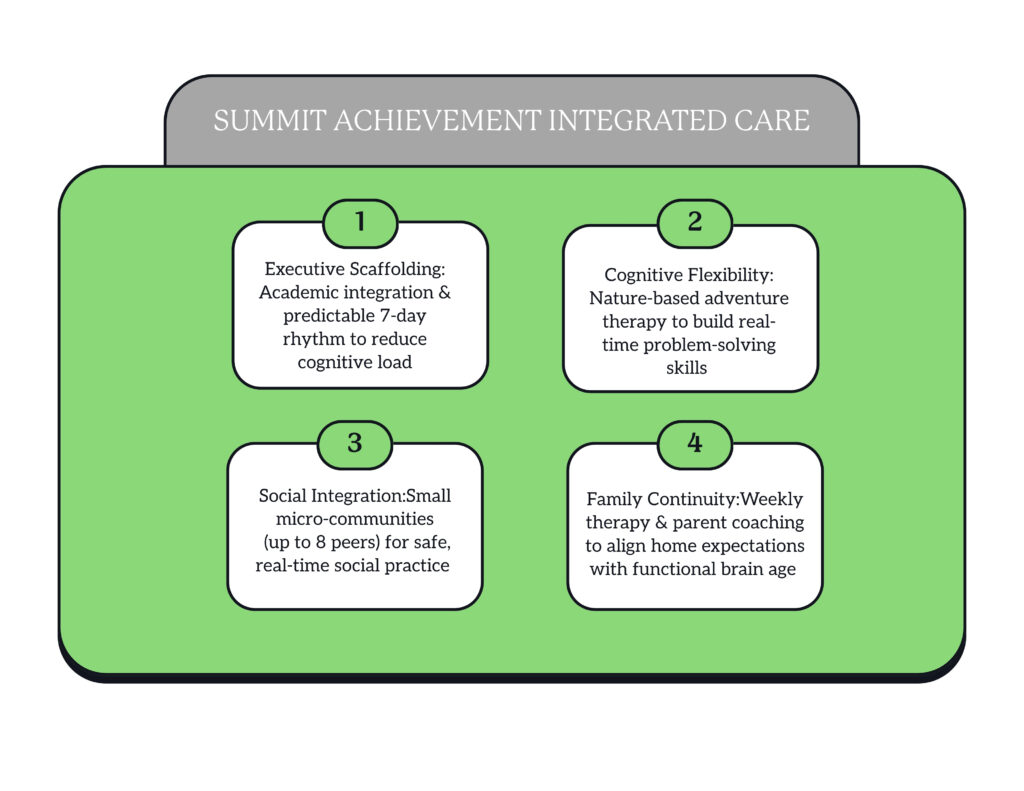
1. Structuring Executive Functioning (Scaffolding the Delayed PFC)
Because the prefrontal cortex in ADHD and ASD can lag by 3 to 5 years, expecting an adolescent to independently manage complex routines without structure leads to overwhelm.
-
Accredited Classroom Integration: Summit pairs a traditional academic setting with hands-on, individualized support. Teachers and therapists scaffold task initiation, time management, and organization in real time, rebuilding academic confidence without overloading executive capacity.
-
Predictable 7-Day Rhythm: The program’s blend of 4 nights on campus and 3 nights in the field provides a structured, repeating framework. Predictable routines lower cognitive load, making it easier for neurodivergent brains to retain and automate self-regulation strategies.
2. Building Cognitive Flexibility Through Outdoor Adventure
For adolescents on the autism spectrum, cognitive rigidity—viewing situations in strict black-and-white terms—is often a defense mechanism against sensory and environmental unpredictability.
-
Nature as a Gentle Teacher: Outdoor expeditions naturally present unexpected changes—a sudden change in weather, a shift in trail plans, or adjusting a campsite. Guided by direct-care staff and therapists who view rigidity as a developmental symptom rather than defiance, students practice adaptive thinking in low-stakes, highly supported environments.
-
Real-Time Skill Generalization: When plans change on the trail, guides help students map those experiences back to everyday life—helping them transition those lessons into the classroom, family sessions, and their eventual return home.
3. Safe Social Micro-Communities
Adolescents with ASD1 often experience intense sensory fatigue and struggle to read subtle social cues, particularly in large, fast-paced high school environments.
-
Intentionally Small Peer Groups: Summit operates with small teams (typically up to 8 students supported by 3 direct-care staff and a master’s-level therapist). This low ratio ensures high emotional safety, where social interactions can be moderated and processed in real time.
-
Mixed-Neurotype Peer Practice: Groups include both neurodivergent and neurotypical peers, offering a realistic social environment where students practice active listening, reading body language, and shared decision-making without fear of rejection or bullying.
4. Family-Centered Growth
Recognizing that executive delays don’t disappear overnight, Summit actively involves parents through weekly family therapy, parent coaching, and structured visits. Parents learn how to adjust home expectations to match their child’s functional brain age—ensuring that the supportive scaffolding built at Summit continues seamlessly after graduation.
Take the Next Step for Your Neurodivergent Teen
If your teenager is struggling with their mental health, executive dysfunction, or difficulty within the family system, you don’t have to navigate it alone. Summit Achievement’s hybrid wilderness and academic model provides the structured support neurodivergent brains need to thrive.
Contact the Summit Achievement Admissions Team Today to learn how we can help your family bridge the developmental gap.
Scientific References & Key Sources
-
Shaw, P., et al. (2007). Attention-deficit/hyperactivity disorder is characterized by a delay in cortical maturation. Proceedings of the National Academy of Sciences (PNAS), 104(49), 19649-19654.
-
Tang, G., et al. (2014). Loss of mTOR-dependent macroautophagy causes autistic-like synaptic pruning deficits. Neuron, 83(5), 1131-1143.
-
Courchesne, E., et al. (2011). Neuron number and size in prefrontal cortex of children with autism. JAMA, 306(18), 2001–2010.