



Parenting a student often feels like walking a tightrope between over-helping and stepping back too far. When teens hit academic walls, our natural instinct as parents is to swoop in, solve the problem, and eliminate their frustration. However, long-term academic success and emotional resilience come from empowering children to take ownership of their own learning journey.
Doug Dobkowski, Special Educator and Summit Achievement’s Academic Director, frames it best:
“Growth is uncomfortable. If you went to the gym with your child and lifted all the weights for them, they would not get stronger.”
To build real strength, students need to do the heavy lifting themselves. Below is a guide on how parents can provide strong, steady support at home without taking over the barbell.
The Parallel Process: Growing Alongside Your Teen
At Summit Achievement, we utilize a specialized parents’ curriculum designed by Krissy Pozatek, LICSW, author of The Parallel Process. This framework helps parents offer grounded guidance at home while their child takes responsibility for their progress. Through weekly family therapy, structured parent coaching, reflective assignments, and in-person visits, parents grow in parallel with their child’s treatment journey.
5 Core Principles of the Parallel Process
To support your child’s academic and emotional growth without over-functioning, focus on these five core principles:
- Emotional Attunement: Connect with your child’s underlying feelings. Serve as a steady compass rather than a reactive sponge—validate their inner experience without rushing in to fix it.
- Reframing Problems: Shift your perspective from controlling behavior to fostering emotional maturity. Look past surface-level homework meltdowns to uncover core anxieties or fears, and avoid viewing their academic struggles as your personal failure.
- Holding Heart-Centered Boundaries: Set clear, calm limits rooted in mutual respect. Maintain healthy boundaries to prevent chaotic power struggles and emotional manipulation.
- Allowing Safe Struggle: Resist the urge to rescue your child from discomfort. Natural consequences build authentic resilience, self-regulation, and problem-solving skills.
- Detaching from the Outcome: Focus energy on your own self-regulation, releasing the need to control your child’s specific timeline. Honor their unique path to independence.
Building an Academic Foundation at Home
Creating an environment where productive academic struggle can happen relies on two essential structural pillars:
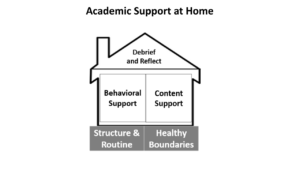
Pillar 1: Structure and Routine
- Make Routine Automatic: Establish a predictable homework structure until it feels as natural as clicking a seat belt.
- Ditch External Bribes: Frame completing schoolwork as a path toward personal growth rather than a transaction for temporary rewards.
- Link Freedom to Responsibility: Consistently remind your student that demonstrating personal responsibility is the primary way they earn independence.
Pillar 2: Healthy Boundaries
Children naturally seek parental attention—and often, negative attention feels just as reinforcing as positive attention.
- Enthuse Over the Positive: Warmly celebrate genuine effort, persistence, and small wins.
- Stay Neutral on the Negative: Remain calm and matter-of-fact when enforcing rules or addressing missing assignments. Use objective observations (e.g., “The portal shows math isn’t turned in”) rather than value judgments (“You’re being lazy”).
Navigating Academic Frustration: Content vs. Behavior
When a student hits a wall with schoolwork, their reaction usually falls into one of two categories:
- Content Frustration: They encounter a concept they don’t understand (e.g., “I don’t get what a scalene triangle is!”) and pivot to side conversations or avoidance.
- Behavioral Frustration: Executive functioning challenges, ADHD, or fatigue trigger an impulsive response of “I just can’t do this.”
Identifying which “room” your child is in helps you determine whether they need a quick physical movement break, executive function support, or a targeted guiding question.
Supporting “Heavy Lifting”: Do’s and Don’ts for Parents
| Don’t (Over-Functioning) | Do (Empowerment) |
| Sit beside them to correct mistakes or answer questions instantly. | Stay available nearby while doing your own work. Reassure them that wrong answers are part of learning. |
| Get drawn into complaints or extinguish minor fires for them. | Take a breath and calmly step away when emotional tension rises. |
| Lecture, nag, or complete assignments on their behalf. | Ask open-ended questions to help them process what is happening. |
| Ally with them to blame teachers or the school system. | Coach them: Ask “Why do you think that happened?” and “What steps will you take next?” |
| Take the lead on solving academic conflicts. | Empower them to create a recovery plan and execute it independently. |
Debrief and Reflect: Turning Tasks into Lasting Growth
Without reflection, homework is just a task to check off a list. A brief post-homework debrief turns daily assignments into long-term character development:
- Highlight Wins: Acknowledge what went smoothly or where persistence paid off.
- Identify Improvement Areas: Discuss what felt challenging and how to approach it differently next time.
- Reflect on Structure: Check if the current study space and time slot are working.
- Promote Independence: Reaffirm healthy boundaries and praise their willingness to work through difficulty safely.
Understanding Your Child’s Homework Personality
Recognizing your child’s default approach to schoolwork allows you to tailor your support effectively:
- The Procrastinator: Developing self-control makes it difficult for them to gauge how long tasks actually take.
- The Perfectionist: Common in high-achieving or gifted students, perfectionism creates anxiety around making mistakes, leading to repeated self-rejection of their own ideas.
- The Speed Demon: Rushes through assignments without engaging with the material, focused entirely on whatever activity comes next.
- The Rebel: Questions authority and assignment relevance, holding strong personal interests outside the standard school curriculum.
- The Forgetter: Frequently misplaces materials, claims to have “no homework,” or assumes deadlines are far in the future due to executive skill delays.
Is Your Teen Struggling Beyond the Classroom?
When academic avoidance, executive dysfunction, or family conflict stem from deeper mental health challenges, structured support can make all the difference. Learn more about Summit’s accredited academic program program here: https://summitachievement.com/the-summit-model/accredited-academics/
At Summit Achievement, we combine compassionate adventure therapy with an accredited academic program to help adolescents build self-reliance, emotional regulation, and scholastic confidence.
Contact our Admissions Team today to learn how our residential treatment program can help your family heal and grow together.